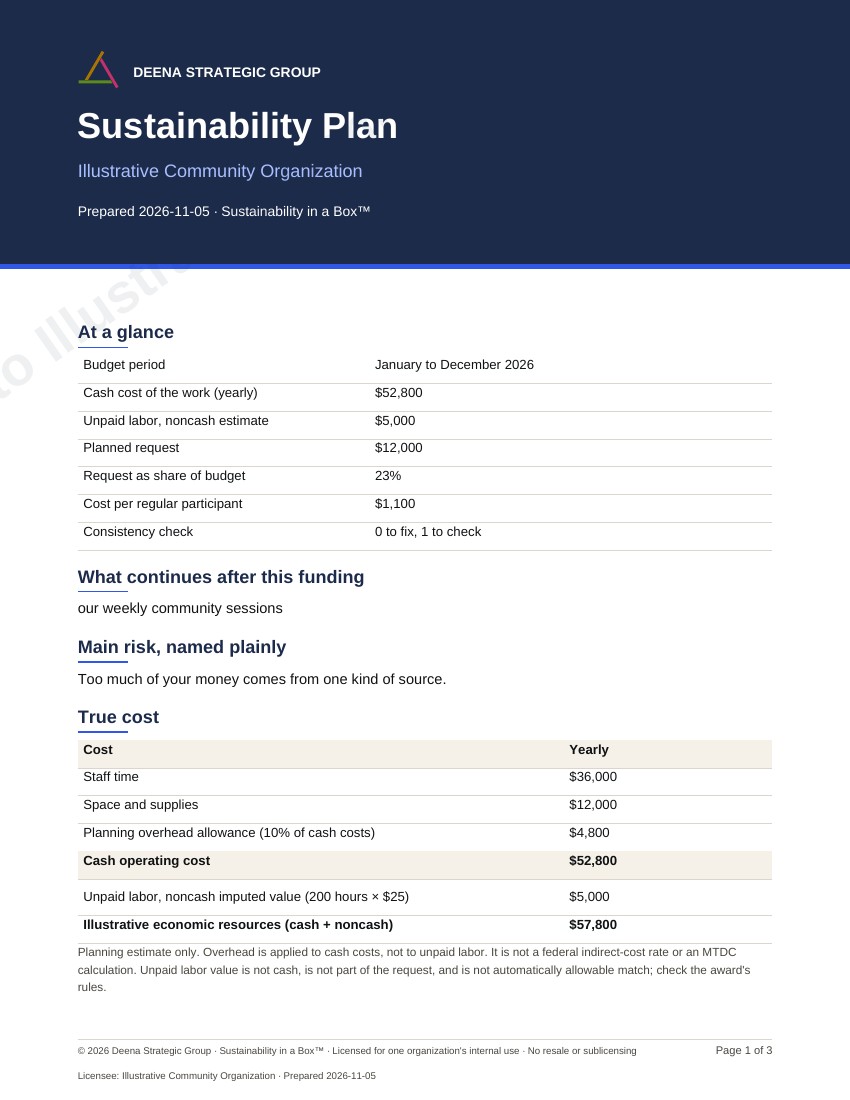
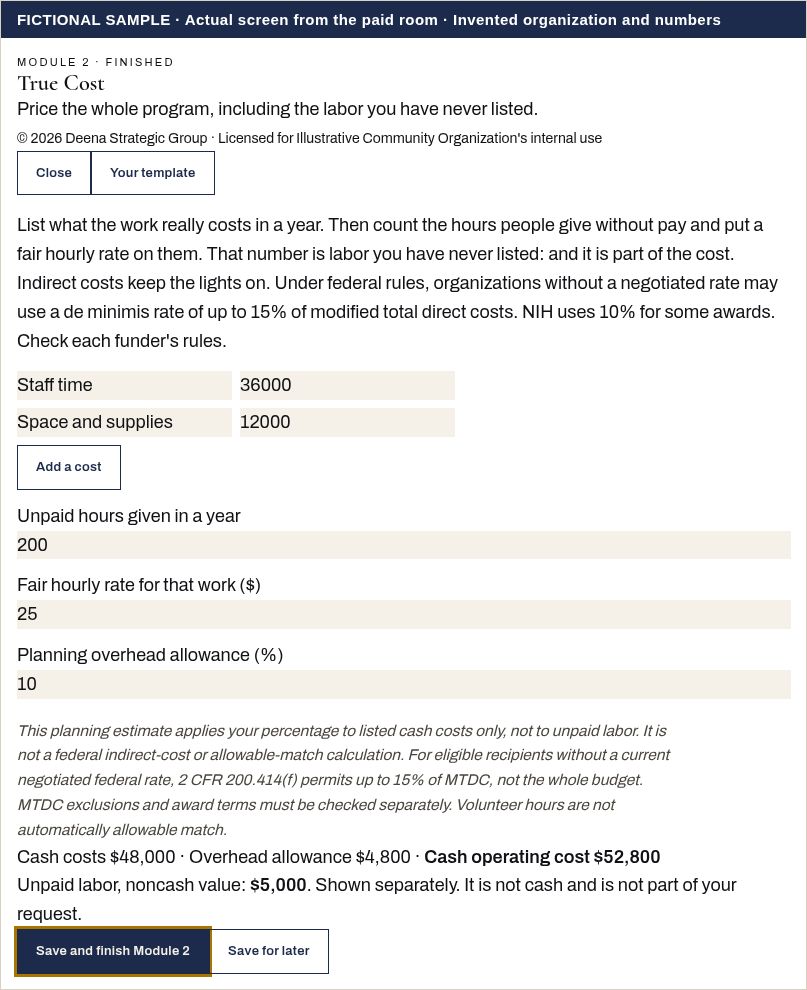
Actual output. Fictional data. Current PDF format and the actual cost module, not client results. No funding is promised.
This is for a small organization doing the work.
You do not have a full development department. You may have kept the work going with volunteers, small gifts and your own time. You know the work. The funding room has its own rules. This teaches you those rules while you build the plan.
This fits if
A funder asked how the work continues after their money ends.
You carry the real costs in your head, not on one page.
Most of your money comes from one place, and you want a second source.
You give hours nobody has ever priced.
Look elsewhere if
You need someone to write a full grant application for you.
You need Medicaid enrollment, billing, claims filing or a compliance review.
Let me show you where the money goes.
We put your staff time, donated hours, supplies and real operating costs on one page. Then we set what you bring in now beside it, source by source, and name the next source to add. That is the plan you take back to the room.
The part they may not tell you.
A budget that does not match your workplan raises questions.
Reviewers read your numbers against your activities. When they do not line up, they read risk.
In your $149 plan: the consistency check compares your budget, request, activities, outcomes and evidence, then lists what to fix before you ask.
Your unpaid labor has value. It is not cash in the account.
Price the hours people give. Keep that number apart from the money you can spend. Blending them makes a budget look bigger than it is.
In your $149 plan: unpaid labor appears as a separate noncash value. It is never added to your cash cost or treated as match.
A reimbursement grant can drain your cash before it pays you.
Some grants pay you back only after you spend. If you cannot cover the wait, a yes can still hurt the work.
This check is not part of the $149 plan. Use the free decision pack to test the cash gap on a specific grant.
Hours people give without pay, and a fair hourly rate
Your planning overhead allowance
What you bring in now: grants, contracts, fees, individual giving and events
Your annual budget and the amount you plan to request
Your activities, the changes you expect and the evidence you have
How many enrolled, attended, how often and for how long
Never enter patient names, IDs, birth dates or diagnoses.
You leave with
A downloadable Sustainability Plan PDF built only from what you entered
The cash cost of the work and the cost per regular participant
Unpaid labor shown as its own noncash value
Your revenue mix by source, with each share and the next source to add
Your request as a share of your budget, flagged above DSG's rule of thumb of about 30%
A consistency check that names what to fix before you ask
A sustainability paragraph assembled from your own answers
The same numbers in a six-tab Excel workbook with live formulas
Saved answers you can come back to, change and download again
How it works
1
Pay once
$149. No subscription.
2
Sign in
Use the email from checkout. Your room opens after the payment is confirmed.
3
Work the eight modules
Plain questions, a short lesson in each, and your answers save as you go.
4
Check your numbers
A consistency check names what to fix before you ask.
5
Download your plan
Take it to your board, your staff or your next funder conversation.
See the eight modules
Resilience Check-in. Ten plain questions that separate the symptom from the cause.
True Cost. Price the whole program, including the labor you have never listed.
Right-Size the Ask. Check whether your request fits the size of your organization.
Revenue Mix. See where your money comes from and the next source to add.
Managing the Money. The checklist that shows a funder their money is handled with care.
Credibility Footprint. What a funder checks about you before they read a word.
Proof. Turn a single number into evidence a reviewer can trust.
Say It Out Loud. Your sustainability paragraph, written from what you entered.
Look inside · Fictional sample
Look inside Sustainability in a Box
Eight saved modules. Shown with an invented community organization and invented numbers.
Made for you if
A funder asked how the work keeps going, and the honest answer is that people are carrying it on unpaid hours.
Community health workers, food and family programs, youth programs and clinics that need to show the full cost of the work and more than one way to pay for it.
You do not get to call it priceless and fund it at zero. This puts a real number on the work, including the hours nobody has paid for yet.
Not this: It does not include Medicaid tools, bill Medicaid, enroll you as a provider or promise a payment.
What you get, counted
1 finished file1 worksheet you keep
Finished files, worksheets and the places you work are counted separately, never added together. Every file is built from your answers the moment you download. Anything you skip prints as Not yet answered, so you can download early and again later.
What you bring
What the work costs, item by item
Unpaid hours people give, and the hourly value you choose
Your budget, your ask and money by source
Your activities and how you know they work
Finished for you, built from your answers
1finished report
Sustainability Plan (PDF)
Worksheets you keep and reuse
6tabs in the Sustainability Numbers Workbook (Excel)
Filled in from your answers. Cash cost, unpaid-labor value and economic resources stay separate.
Start here
Cost lines
True cost
Revenue mix
Activities & evidence
Next steps
Where you work
8saved modules
Each one saves to your account as you go.
Resilience Check-in
True Cost
Right-Size the Ask
Revenue Mix
Managing the Money
Credibility Footprint
Proof
Say It Out Loud
Free templates that pair with it
Free for everyone in the free template library. Not part of the purchase and not counted above.
Unpaid hours people give, and a fair rate for them
The money you have now or could pursue
How it works
Name what must keep going and why it is fragile.
Price the full cost. Unpaid labor is counted separately, never as cash.
Right-size the ask and map every source of money.
Check that your numbers agree with each other.
Download your Sustainability Plan PDF and your numbers in Excel.
You leave with
A Sustainability Plan PDF: what continues, itemized costs, priced unpaid labor kept separate, your revenue mix and the next source to add. The same numbers in an editable Excel workbook.
Actual screen · fictional data
Price the whole program, including labor never billed.
Cash costs and the value of unpaid hours are kept apart, so the plan never overstates what you spend.
What it does not do. Medicaid tools are not included. No DSG review, no enrollment, billing, claims or payer contracts. No payment, contract or eligibility is promised.
Thirty-plus years of senior institutional leadership, United Way allocations, corporate and major gifts, and program design. I have sat on the side of the table where funding gets decided. This puts those rules in your hands.