
    Build My Grant Application & Funding Case · $350 · one time

    You know your community. The application keeps asking you to explain it in somebody else's language.

    Paste the actual application. Then say what is different about this place, what people closest to the work know, and who decides what counts. Those answers change the program design, the measures, the budget and every draft you download.

    For: One real application you have in hand

    Illustration: an application's questions connected one by one to answer pages, with an outcomes chart and a budget check.

    Bring

    • The application or guidelines, pasted in
    • Your program facts and budget
    • What people closest to the work know, and how you learned it

    In your guided workspace

    1. Requirements read from the application you paste
    2. What is different here, community knowledge with consent and source, and measures your community defines
    3. Design, logic model, measures, budget and drafts rebuilt from those answers; anything unproven stays marked unknown

    You keep

    Your application draft in Word and PDF, a saved Grant Evidence & Monitoring Workbook and a saved Grant Cycle & Program Record.

    Included tools 21 ready
    • ReadyGrant Builder draft Reads the requirements you paste and drafts narrative, outcomes and evaluation against them; Word and PDF. The same reader is free to try; your latest draft stays on your account either way.
    • ReadyEvery draft kept with your grants Bring each saved Grant Builder draft into your Grant Cycle record: a grant row, its indicators, budget lines for you to price, and the drafted sections with their own Word download. Bringing it in again updates the draft and never duplicates the grant.
    • ReadyGrant Evidence & Monitoring Workbook Nine sections tied to one grant: logic model, metric dictionary, evidence ledger, before-and-after plan, grant obligations, learning review and decision log, retained value, monitoring and review. Print to PDF from your browser.
    • Not builtFunder research or matching Deliberately not built. You bring the opportunity.
    • ReadyTheory of change and logic model If-then-because statement; resources, activities, outputs, near, mid and long-term outcomes; assumptions and outside influences, with checks that outputs are not passed off as outcomes.
    • ReadySMART objectives and indicator matrix Baseline, unit, target, actual, source, how often, owner. Progress toward target is calculated; missing numbers stay unknown.
    • ReadyGrant pipeline and award money Source link and date checked, stage, deadline, award terms, report and renewal dates, drawdowns, payments received, money not yet received, claim status, budget against actual with variance reasons.
    • ReadyReimbursement float and match Cash gap before first payment; cash match and in-kind kept separate.
    • ReadyBoard, meetings and filings Roster with terms and conflict statements, quorum from your bylaws checked against each meeting, adopted-minutes log, disclosure register and a filing calendar where you record the official source and date checked. No filing date is assumed.
    • ReadyThe Underneath: cause to outcome Documented history and structure beneath the problem, what your program acts on, and community and kinship assets with how you know them. Feeds the statement of need; flags deficit wording.
    • ReadyOrganization profile One-page profile from your record: mission, place, people served, budget, program, board and filings.
    • ReadyCloseout and renewal Report owner, closeout due date and final report date per award. A grant marked closed without a final report or with money still owed is flagged.
    • ReadyReviewer red flags Checks your narrative, budget, workplan, outcome evidence and the website and Candid numbers you copy in against each other. Reads only your record; not a review by DSG or a funder.
    • ReadyWorkplan Activity, dates, owner and output, checked against the grant period.
    • ReadyFederal SF-424A style budget view Optional, for federal notices that require the SF-424A. Groups your lines into the form's Section B object classes with your own indirect amount and basis. No default rate; not the form itself.
    • ReadyProposal drafts and letters from your facts Statement of need, executive summary, program narrative, case for support, letter of inquiry, cover letter, budget justification, partner letter request, donor thank-you and funder progress email. Built only from what you enter; gaps stay [bracketed].
    • ReadyBoard snapshot One page: indicator progress, grant money, budget against actual, dates due, decisions needed. Aggregate numbers only.
    • ReadyDownloads Full record as PDF and Word, board snapshot as PDF, thirteen proposal drafts in Word and PDF, pipeline as CSV, and a ten-tab Grant Lifecycle Workbook in Excel with live formulas.
    • ReadyFunder fit and trusted relationships Per grant: what the funder says it funds in its own words and where that came from, and how it already knows your work. A relationship reaches your letter only when you mark that they agreed to be mentioned. DSG supplies no contacts or funder lists.
    • ReadyHunches kept apart from facts Write down what your intuition tells you and how you will check it. A hunch stays out of every draft until you mark it confirmed and say what confirmed it.
    • ReadySeven built-in reviews The Underneath, governance in context, funder fit, evidence quality, institutional translation, source review and money risk, each showing what is still open. Built-in rules that read only your record; not AI and not a DSG review.
    • Not builtAI reading this room Nothing in this room is sent to an AI model. Every check is a fixed DSG rule that reads only what you typed.
    • PartialBring in what you already typed Press a button to bring in a grant from the free Decision Pack, any Grant Builder draft saved under your sign-in, and blank fields from your City & County room. The Evidence Workbook does not feed it yet.
    • ReadyOrganization facts across your rooms Name, mission, place, people served, budget, contact and program name you saved in your Get Me Ready, Sustainability or City & County room fill blank fields here when you press the button. Nothing you typed is overwritten; rooms that disagree are shown so you can settle the number.
    • Not builtDeadline reminders by email Dates show when you open the room. Nothing is sent.

    Fictional preview Fictional: letter of inquiry to Riverbend Community Foundation for $40,000, with two [bracketed] facts still to add.

    Your work product: An application draft in Word and PDF, a saved workbook and a saved grant-cycle record.

    How it works

    Answer the application in front of you.

    1. Paste the real application

      The guidelines or questions from the funder, as published. No imagined template.

    2. See what it actually asks

      The builder lists the requirements it reads in your text, so you answer those and nothing else.

    3. Say what is different here

      This place, its barriers, the trust pathways the work travels through, and what people closest to the work know, each with its source and consent.

    4. Build the case from that

      Program design, logic model, measures, budget and narrative change with those answers. Required measures stay beside the ones your community defines.

    5. Check the numbers and the claims

      The budget is checked against the work. Anything you have not shown stays marked unknown. Nothing is turned into proof of cause.

    6. Leave with it

      Export to Word and PDF. Your paid level keeps a saved Grant Evidence & Monitoring Workbook and a Grant Cycle & Program Record with thirteen drafts, including an evaluation and measurement plan.

    Fictional example · computed by the room's own code

    What is different here changes the draft.

    Most proposal tools fill a template. This room asks what a template cannot know, and the answers change what you send. Your community's knowledge counts as evidence when you record it like evidence: who holds it, how you learned it, where it holds and whether people agreed to share it.

    The room asks

    1. What is different about this place, this group and your organization?
    2. Which histories, public-policy or eligibility barriers shape the work?
    3. Which relationships, informal care and trust pathways does the work travel through?
    4. What do people closest to the work know, how did you learn it, and did they agree to share it?
    5. What change can actually be observed here, and who defines and checks that measure?

    Sample answers (Eastside Tenant Circle, invented)

    Different here
    Three Eastside blocks where most families have rented from the same out-of-area owners for decades, and where many households speak Spanish or Haitian Creole at home.
    Barriers
    Eviction notices arrive only in English with legal wording, the court gives days rather than weeks to respond, and the closest courthouse is two bus transfers away. Source: County court notice forms and calendar rules, read October 2026; bus route map (fictional).
    Trust pathways
    Renters first call a tenant leader or a church translator, not an agency. Word moves through the phone tree and Sunday announcements.
    Knowledge 1
    People do not open a court envelope until someone they trust tells them it is safe to read. Tenant leaders; Leader meetings over six years of clinics; Observed by us; Cleared to share, naming the group.
    Knowledge 2
    Families arrive at court on time when a neighbor rides with them. Clinic participants; Two report-back nights, tallied by hand; Told to us (self-report); Cleared to share, without naming anyone.
    Knowledge 3
    One landlord delays repairs after any tenant attends a clinic. Two tenants; Private conversation at a clinic; Told to us (self-report); Not cleared to share.

    What those answers added to the downloaded drafts

    Statement of need

    • What is different here. Three Eastside blocks where most families have rented from the same out-of-area owners for decades, and where many households speak Spanish or Haitian Creole at home
    • Barriers people meet. Eviction notices arrive only in English with legal wording, the court gives days rather than weeks to respond, and the closest courthouse is two bus transfers away (Source: County court notice forms and calendar rules, read October 2026; bus route map (fictional))

    Program narrative

    • How the work travels. Renters first call a tenant leader or a church translator, not an agency. Word moves through the phone tree and Sunday announcements
    • What community knowledge changed in this design.
    • Tenant leaders, not staff, make the first call after a filing. Why: People do not open a court envelope until someone they trust tells them it is safe to read (Tenant leaders; observed by us).
    • Add shared rides to the court-day plan. Why: Families arrive at court on time when a neighbor rides with them (shared without attribution; told to us (self-report)).
    • What people closest to the work know, shared with consent.
    • People do not open a court envelope until someone they trust tells them it is safe to read (Tenant leaders; Leader meetings over six years of clinics, 2026-03-10; observed by us; holds for The three Eastside blocks we work in).
    • Families arrive at court on time when a neighbor rides with them (shared without attribution; Two report-back nights, tallied by hand, 2026-10-14; told to us (self-report); holds for Hearings at the county courthouse).

    Budget justification

    • Tenant leader stipends: $7,200. Basis: 6 leaders × $100/month × 12 months. Why this place needs it: Renters call a tenant leader before they call any agency; the leaders carry the trust the clinics run on.
    • Costs this context points to that are not priced yet:
    • [Interpretation and translation: amount and basis]
    • [Transportation (fares or rides): amount and basis]
    • [Community measure validation sessions (stipends, food, space): amount and basis]

    Evaluation and measurement plan

    • Measures the funder requires.
    • Households attending hearing with a written plan (% of households seen): baseline 35, target 70, from Follow-up log (aggregate), quarterly. Required by the funder; defined by Riverbend Community Foundation reporting form (fictional); how it is observed: Organizer checks for a written plan at the follow-up call; observed by us.
    • Measures defined with the community.
    • People who would send a relative or neighbor to a clinic (% of people asked): baseline unknown, target [target], from Follow-up question, tally only, quarterly. Defined with the community; defined by Tenant leaders at the March 2026 planning meeting (fictional); checked with Clinic participants at two report-back nights; how it is observed: One question at the follow-up call, asked by a tenant leader; tally only; told to us (self-report).
    • Households still in touch six months after their hearing (households): baseline unknown, target [target], from Phone tree contact log (aggregate), quarterly. Defined with the community; defined by Tenant leaders and long-time phone tree members (fictional); checked with Clinic participants at two report-back nights; how it is observed: Phone tree log of who answered a check-in call; counted, no names reported; verified in a record.
    • Our own counts.
    • Clinics held (clinics): baseline 0, target 48, from Clinic calendar, monthly. Our own count; how it is observed: Count of clinics on the calendar; verified in a record.
    • We report what we observed or verified in records separately from what people tell us, and we mark our own interpretations as interpretations.

    Budget: the room points to interpretation and translation, transportation (fares or rides), community measure validation sessions (stipends, food, space), read from the answers. It suggests no amounts. You price them.

    Consent holds: knowledge 3 was not cleared to share. It appears in none of the thirteen drafts.

    Community knowledge explains how things work in a place. The room never turns it into proof that a program caused a result, never writes quotes, interviews or results you did not enter, and never states who is eligible for Medicaid or any public program. The funder's required measures stay in the plan beside the ones your community defines.

    Look inside · Fictional sample

    Look inside Build My Grant Application

    One real application, worked from the guidelines you paste in and from what is true about your place. The fictional tenant group below is applying to an invented foundation.

    Made for you if

    One real application is open in front of you, and you are tired of rebuilding your story from scratch for every funder.

    Staff and board members of community organizations applying for a specific foundation, corporate or public grant who want the draft, the evidence and the budget to agree with each other.

    You already know the people. The challenge is showing the funder what you know without making your community sound like a problem waiting for permission.

    Not this: It does not search for grants, match you to funders or submit anything for you.

    What you get, counted

    8 finished files2 worksheets you keep

    Finished files, worksheets and the places you work are counted separately, never added together. The draft is finished as far as your facts go. Anything you have not given stays marked missing, with what to add. A person still reads it before it is sent.

    What you bring

    • The application questions or guidelines, pasted in
    • Your program facts, numbers and partners
    • Any evidence you already have, and where it came from
    • Your budget lines and how you calculated them

    Finished for you, built from your answers

    • 2 Grant Builder files

      Built against the guidelines you paste in.

      • Application draft (Word)
      • Application draft (PDF)
    • 6 files from your Grant Cycle record

      The proposal drafts: Statement of need, Executive summary, Program narrative, Case for support, Letter of inquiry, Cover letter, Budget justification, Partner letter request, Donor thank-you and update, Organization profile, Funder progress email, Evaluation and measurement plan, Note to the funder: what makes this award workable.

      • Board snapshot, for your board packet (PDF)
      • Full record (PDF)
      • Full record (Word)
      • Proposal drafts and letters, 13 drafts (Word)
      • Proposal drafts and letters, 13 drafts (PDF)
      • Grant list (CSV)

    Worksheets you keep and reuse

    • 1 Grant Evidence & Monitoring Workbook

      9 sections tied to this grant: Logic model, Metric dictionary, Evidence ledger, Before and after plan, Grant obligations, Learning review and decision log, Retained value, Monitoring, Review. Saved to your account; print it to PDF.

      • Grant Evidence & Monitoring Workbook
    • 10 tabs in the Grant Lifecycle Workbook (Excel)

      Filled in from your record. Formulas stay live, so it keeps working after you download it.

      • Start here
      • Prospects
      • Calendar
      • Awards & payments
      • Budget vs actual
      • Float & match
      • Reports & renewals
      • Workplan & partners
      • Outcomes
      • Board & filings

    Where you work

    • 7 parts in the included Grant Cycle & Program Record

      One saved record for your grants, money, outcomes and board.

      • Organization and need
      • Board and filings
      • Underneath and theory of change
      • Objectives and indicators
      • Grants and money
      • Red flags and drafts
      • Board snapshot and downloads

    Free templates that pair with it

    Free for everyone in the free template library. Not part of the purchase and not counted above.

    You bring

    • The application questions or guidelines, pasted in
    • Your program facts, numbers and partners
    • Any evidence you already have, with where it came from

    How it works

    1. Paste the opportunity. The Grant Builder lists what it actually asks.
    2. Answer in your words. The draft is built from your facts only.
    3. Bring the draft into your Grant Cycle & Program Record.
    4. Say what is different about this place and what people closest to the work know, with consent and source. Mark which measures the funder requires and which your community defines.
    5. Those answers rebuild the logic model, measures, budget and drafts. Check it with seven built-in reviews, then download.

    You leave with

    Your application draft in Word and PDF, a saved Evidence & Monitoring Workbook, and a Grant Cycle & Program Record (PDF and Word) that holds the draft beside your logic model, measures, budget lines, deadlines and reports. The record also gives you thirteen proposal drafts in Word and PDF, including an evaluation and measurement plan, built from what is true about your place, plus a board snapshot and a ten-tab Excel workbook.

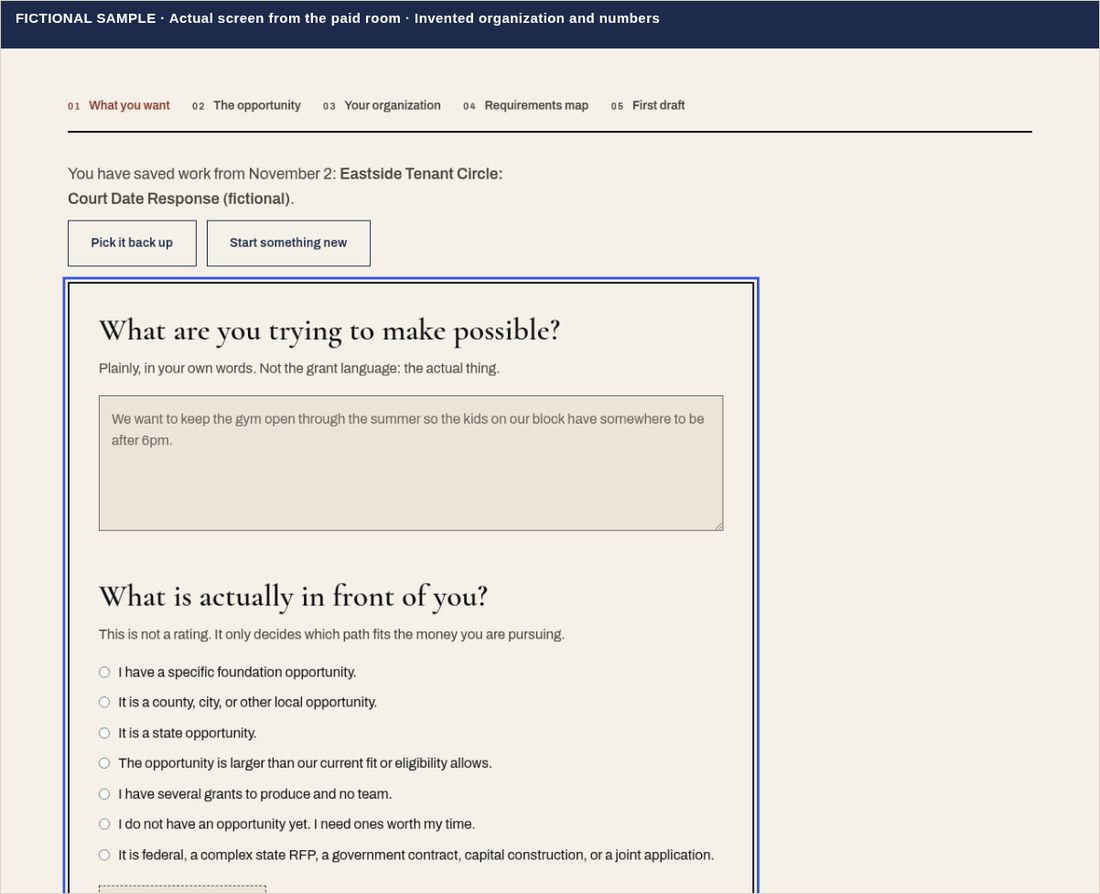
    Actual screen · fictional data

    Start from what is actually in front of you.

    Your saved work waits for you. The builder asks what you want to make possible before it reads the opportunity.

    Grant Builder screen asking what you are trying to make possible and what opportunity is in front of you, with a saved project to pick back up.
    Open full size (opens in a new tab)

    What it does not do. No person reviews your draft, nothing is submitted for you, and no award is promised. The builder does not find grants or match you to funders.

    Fictional example · not a real funder

    From the requirement to your evidence.

    FICTIONAL · requirement crosswalk for an after-school program
    The application asksYour stated evidenceGap or next step
    Describe the needFamily interview notesConfirm dates and consent
    Itemized budgetRent and staffing quotesConfirm period and shared costs
    Explain the change you expectAttendance logShows participation, not cause; stays marked

    Free draft or $350?

    Free draft

    Sign in, paste the application and get a draft with what is missing named, in Word or PDF. Your latest draft stays on your account so you can pick it up again. That is all it keeps.

    $350 self-directed

    The same builder, plus two saved rooms. The Grant Evidence & Monitoring Workbook keeps your evidence, outcomes and open questions with the application. The Grant Cycle & Program Record holds every Grant Builder draft you bring in, beside your logic model, indicators, budget lines with checks, deadlines, award money and reports, with PDF and Word downloads.

    Not included

    A person's review, submission, funder matching or any promise of an award.

    Two $350 rooms. Which one is yours?

    Your organization

    Get Me Ready to Pursue the Money™

    Use it before any specific grant, when you are not sure your records, numbers and language will hold up.

    You keep: A Capital Pursuit Brief™ PDF, your corrected language in Word and a saved Grant Cycle & Program Record.

    It does not write a grant application.

    See the six modules →

    One real application · this page

    Build My Grant Application & Funding Case

    Use it when an application is open and you need a case that answers its actual questions.

    You keep: Your application draft in Word and PDF, a saved Grant Evidence & Monitoring Workbook and a saved Grant Cycle & Program Record.

    It does not fix your organization's records or language.

    Have both problems? If the deadline is close, start with the application. If the basics are shaky, start with Get Me Ready.

    Talk it through with a person

    One question is enough. Tell us where you are, and a person reads it.