
    Find City & County Funding & Prepare to Apply · $475 · one time

    Before you apply for city money, learn what the city was actually paid, or committed, to do.

    Your city is spending money to solve something. Do you know what it promised to solve, and whether your work belongs in that plan? This room teaches you to read the front and back of municipal money: where it came from, what it was promised to do, what you can honestly deliver, and how you prove it after the award.

    For: Community organizations whose work could carry part of a city or county promise

    Illustration: a city hall above an open budget book, with one budget line traced to a project plan, a metric chart and a source ledger.

    Bring

    • Your city, county and state
    • Links to the budgets, award letters, plans or notice you found
    • What your work already does, its costs and who takes part

    In your guided workspace

    1. Find who received the money, where it was appropriated and which agency controls the contracts
    2. Trace each dollar to its source: federal or state pass-through, general fund, levy, earmark or philanthropy
    3. Quote what the city promised, from the adopted document, and mark speeches as not money
    4. Name your honest role, your limits, your measures and what is required after award

    You keep

    A Source-to-Commitment-to-Delivery-to-Evidence Record in Word and a City and County Funding Decision Record PDF that opens with it: who received the money and where the door is, where the money came from, what they promised, what you can deliver, how you prove it. Plus a saved Grant Cycle & Program Record.

    Included tools 22 ready
    • ReadyMoney trail ledger Where each dollar started (federal or state pass-through, general fund, levy, earmark, philanthropy), who received it, where it was appropriated, which agency controls the contracts, the office, fiscal year, amount as written and its quoted restrictions.
    • ReadyPromise ledger What the city or county committed to solve, quoted from the adopted document, with department, measure, deadline and approval. Speeches and press releases are marked as not money.
    • ReadyYour role and your proof What your work already does, what sits underneath it here, what the money would pay for, what you will not claim, your measures, and reporting and closeout after award.
    • ReadySource-to-Commitment-to-Delivery-to-Evidence Record (Word) and Decision Record (PDF) Six door questions answered from your entries, then where the money came from, what they promised, what you can deliver and how you prove it, from your entries. Missing facts print as missing; crime and eligibility overclaims are flagged.
    • Not builtLive budget data feed Deliberately not built. You supply the official documents.
    • ReadyTheory of change and logic model If-then-because statement; resources, activities, outputs, near, mid and long-term outcomes; assumptions and outside influences, with checks that outputs are not passed off as outcomes.
    • ReadySMART objectives and indicator matrix Baseline, unit, target, actual, source, how often, owner. Progress toward target is calculated; missing numbers stay unknown.
    • ReadyGrant pipeline and award money Source link and date checked, stage, deadline, award terms, report and renewal dates, drawdowns, payments received, money not yet received, claim status, budget against actual with variance reasons.
    • ReadyReimbursement float and match Cash gap before first payment; cash match and in-kind kept separate.
    • ReadyBoard, meetings and filings Roster with terms and conflict statements, quorum from your bylaws checked against each meeting, adopted-minutes log, disclosure register and a filing calendar where you record the official source and date checked. No filing date is assumed.
    • ReadyThe Underneath: cause to outcome Documented history and structure beneath the problem, what your program acts on, and community and kinship assets with how you know them. Feeds the statement of need; flags deficit wording.
    • ReadyOrganization profile One-page profile from your record: mission, place, people served, budget, program, board and filings.
    • ReadyCloseout and renewal Report owner, closeout due date and final report date per award. A grant marked closed without a final report or with money still owed is flagged.
    • ReadyReviewer red flags Checks your narrative, budget, workplan, outcome evidence and the website and Candid numbers you copy in against each other. Reads only your record; not a review by DSG or a funder.
    • ReadyWorkplan Activity, dates, owner and output, checked against the grant period.
    • ReadyFederal SF-424A style budget view Optional, for federal notices that require the SF-424A. Groups your lines into the form's Section B object classes with your own indirect amount and basis. No default rate; not the form itself.
    • ReadyProposal drafts and letters from your facts Statement of need, executive summary, program narrative, case for support, letter of inquiry, cover letter, budget justification, partner letter request, donor thank-you and funder progress email. Built only from what you enter; gaps stay [bracketed].
    • ReadyBoard snapshot One page: indicator progress, grant money, budget against actual, dates due, decisions needed. Aggregate numbers only.
    • ReadyDownloads Full record as PDF and Word, board snapshot as PDF, thirteen proposal drafts in Word and PDF, pipeline as CSV, and a ten-tab Grant Lifecycle Workbook in Excel with live formulas.
    • ReadyFunder fit and trusted relationships Per grant: what the funder says it funds in its own words and where that came from, and how it already knows your work. A relationship reaches your letter only when you mark that they agreed to be mentioned. DSG supplies no contacts or funder lists.
    • ReadyHunches kept apart from facts Write down what your intuition tells you and how you will check it. A hunch stays out of every draft until you mark it confirmed and say what confirmed it.
    • ReadySeven built-in reviews The Underneath, governance in context, funder fit, evidence quality, institutional translation, source review and money risk, each showing what is still open. Built-in rules that read only your record; not AI and not a DSG review.
    • Not builtAI reading this room Nothing in this room is sent to an AI model. Every check is a fixed DSG rule that reads only what you typed.
    • PartialBring in what you already typed Press a button to bring in a grant from the free Decision Pack, any Grant Builder draft saved under your sign-in, and blank fields from your City & County room. The Evidence Workbook does not feed it yet.
    • ReadyOrganization facts across your rooms Name, mission, place, people served, budget, contact and program name you saved in your Get Me Ready, Sustainability or City & County room fill blank fields here when you press the button. Nothing you typed is overwritten; rooms that disagree are shown so you can settle the number.
    • Not builtDeadline reminders by email Dates show when you open the room. Nothing is sent.

    Fictional preview Fictional: a city's $5,000,000 state violence prevention award traced to its adopted plan goal, a youth jobs program's honest role and the city's own measure.

    Your work product: A Source-to-Evidence Record in Word, a Funding Decision Record PDF and a saved grant-cycle record.

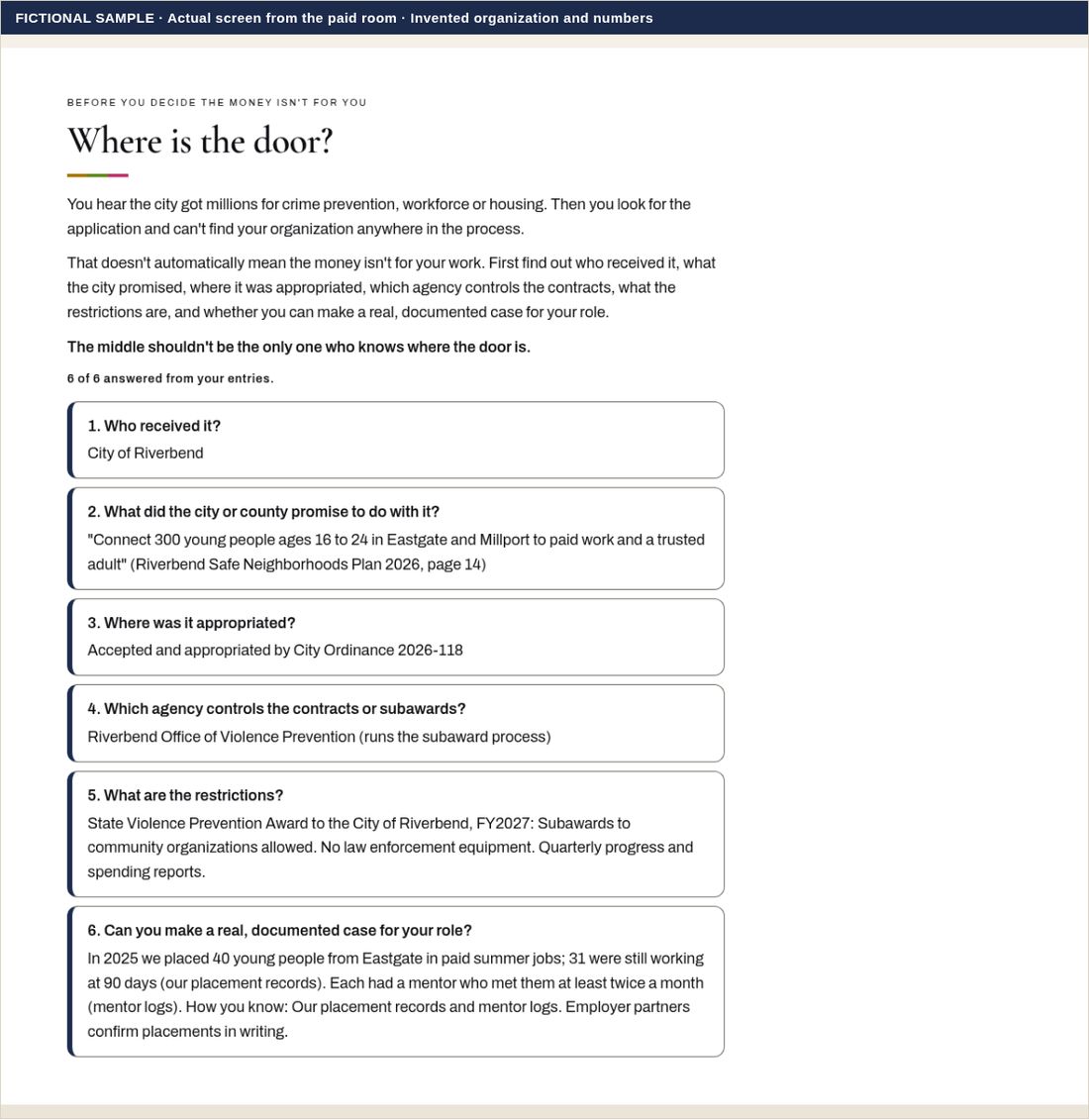
    Before you decide the money isn't for you

    You can't find your organization anywhere in the process.

    You hear the city got millions for crime prevention, workforce or housing. Then you look for the application and can't find your organization anywhere in the process.

    That doesn't automatically mean the money isn't for your work. First find out who received it, what the city promised, where it was appropriated, which agency controls the contracts, what the restrictions are, and whether you can make a real, documented case for your role.

    1. Who received it?
    2. What did the city or county promise to do with it?
    3. Where was it appropriated?
    4. Which agency controls the contracts or subawards?
    5. What are the restrictions?
    6. Can you make a real, documented case for your role?

    The middle shouldn't be the only one who knows where the door is. No one teaches this. The room does, one question at a time, and keeps track of which ones you have answered.

    The part nobody teaches

    To get municipal money, understand where municipal money comes from.

    What a city is trying to solve is what it has promised to solve. Your job is to make sure what you are solving is the same thing, and to say so in their words, without bending the work.

    Most organizations only see the notice. By then the money already has a source, a purpose, restrictions and a measure someone has to report to council. This room teaches you to read all of it, front and back.

    1. Source: where the money came from

      Trace each dollar to where it started: federal or state money passed through the city, the general fund, a levy, an earmark or philanthropy. Log who received it, where it was appropriated, which agency controls the contracts, the office, fiscal year, amount as written and the restrictions that travel with it.

    2. Commitment: what they promised

      Quote what the city or county committed to solve, from the adopted budget, the council vote, the plan or the measure the department reports. Speeches and press releases go in too, marked as not money.

    3. Delivery: what you can deliver

      Say what your work already does, how you know, and what sits underneath it here: the history, kinship and trust that let you reach people. Then name the piece this money would pay for, and what you will not claim.

    4. Evidence: how you prove it

      Outputs you count, outcomes that change for people, a baseline or "unknown," and what the source requires after award: reports, data, monitoring and closeout.

    Fictional worked example · invented city, organization and numbers

    The city received $5 million for public safety. Where does a youth jobs program fit?

    Eastgate Youth Works (fictional) did not start with the notice. It started with the money, then the promise, then its own honest part of it.

    FICTIONAL · City of Riverbend money-to-proof chain

    1. Source

      • State money passed through the city: $5,000,000 awarded to the City of Riverbend for violence prevention, FY2027.
      • Received by the City of Riverbend. Appropriated by Ordinance 2026-118. Contracts run by the Office of Neighborhood Safety.
      • Restrictions, quoted: subawards to community groups allowed; no law enforcement equipment; quarterly reports.
      • Plus $450,000 from the city's general fund, adopted budget.
    2. Commitment

      • Adopted plan goal: "Connect 300 young people ages 16 to 24 in Eastgate and Millport to paid work and a trusted adult." Council Resolution 26-41.
      • Their measure: young people placed; share still working at 90 days.
      • The mayor's speech, "We will end youth violence in four years": logged, marked not money.
    3. Delivery

      • 40 young people placed last year; 31 still working at 90 days (their records).
      • Mentors grew up in Eastgate; families come through two churches and a barbershop network (referral log, partner letters).
      • The ask: paid summer jobs for 60, mentoring twice a month for a year.
    4. Evidence

      • Count placements and mentoring contacts. Track 90-day retention and whether young people have a trusted adult.
      • Baseline: 31 of 40. Target: 45 of 60.
      • Quarterly reports, records kept three years, 45-day reimbursement they can carry for two months.

    What the brief keeps out. The room flags these when you type them, so you can rewrite before a reviewer reads them:

    • "Our mentoring stops crime." A program can contribute to a safety plan. It cannot claim it lowered citywide crime.
    • "We automatically qualify for federal dollars." Fit is not eligibility. The source's own rules decide.
    • A speech treated as a commitment. Rhetoric is not an appropriation.

    What it says instead: what you will do, for whom, what you will count, and the city's own measure it feeds.

    Look inside · Fictional sample

    Look inside City & County Funding

    An invented city received $5 million in state violence prevention money. A fictional youth jobs program traced where it came from, what the city promised to do with it, and the honest part its own work could carry.

    Made for you if

    Local money seems to go to the same organizations every year. You want to know where it came from and what the city promised to do with it before the next round.

    Community organizations, coalitions and fiscally sponsored projects working with a city or county, whether or not a funding notice has been posted yet.

    Your city is spending money to solve something. Make sure what you are solving is the same thing. This room teaches the front and back of municipal money the way the people who already get funded read it.

    Not this: It does not search government sites, verify sources, decide eligibility or promise that a program will open.

    What you get, counted

    12 finished files1 worksheet you keep

    Finished files, worksheets and the places you work are counted separately, never added together. Your brief and decision record are built from what you logged. Missing facts print as missing. Every source prints as Recorded by you, because the room does not check government sites for you.

    What you bring

    • Your city, county and state
    • Links to the budget, award letters, plans or notice you found
    • What your work already does, its cost and who takes part

    Finished for you, built from your answers

    • 6 finished files from your answers

      • Source-to-Commitment-to-Delivery-to-Evidence Record: six door questions, then where the money came from, what they promised, what you can deliver, how you prove it (Word)
      • City and County Funding Decision Record, opening with the same record (PDF)
      • Public Commitment & Performance Alignment Brief, from your Follow the Money investigation (PDF)
      • The same brief (Word)
      • Mission-to-Public-Commitment Alignment Brief, from Position Your Mission (PDF)
      • The same alignment brief (Word)
    • 6 files from your Grant Cycle record

      The proposal drafts: Statement of need, Executive summary, Program narrative, Case for support, Letter of inquiry, Cover letter, Budget justification, Partner letter request, Donor thank-you and update, Organization profile, Funder progress email, Evaluation and measurement plan, Note to the funder: what makes this award workable.

      • Board snapshot, for your board packet (PDF)
      • Full record (PDF)
      • Full record (Word)
      • Proposal drafts and letters, 13 drafts (Word)
      • Proposal drafts and letters, 13 drafts (PDF)
      • Grant list (CSV)

    Worksheets you keep and reuse

    • 10 tabs in the Grant Lifecycle Workbook (Excel)

      Filled in from your record. Formulas stay live, so it keeps working after you download it.

      • Start here
      • Prospects
      • Calendar
      • Awards & payments
      • Budget vs actual
      • Float & match
      • Reports & renewals
      • Workplan & partners
      • Outcomes
      • Board & filings

    Where you work

    • 7 steps in Position Your Mission to Move Capital

      Stage 2 of Follow the Money. A fictional organization shows each step.

      • Your mission
      • Programs and evidence
      • Their objective
      • Genuine overlap
      • Measurable contribution
      • Your offer
      • Your words
    • 7 steps in the Follow the Money investigation

      Taught with five real Columbus routes, each read from the public record with its date.

      • Place and program
      • The original award
      • Every hop
      • Who answers for it
      • What was promised
      • What happened
      • Your legitimate route
    • 11 saved sections

      Three of them are row-by-row worksheets: Money trail ledger, Promise ledger, Opportunity worksheet. Plus a guide for reading a notice, or for finding money when there is no notice yet.

      • Location and jurisdiction
      • Eligibility facts
      • Find where the money is already written down
      • Where the money came from: money trail ledger
      • What they promised: promise ledger
      • Grant or procurement?
      • Opportunity worksheet
      • What you can deliver: your role in their plan
      • How you prove it: measures and what happens after award
      • Credible budget
      • Decision and next steps
    • 7 parts in the included Grant Cycle & Program Record

      One saved record for your grants, money, outcomes and board.

      • Organization and need
      • Board and filings
      • Underneath and theory of change
      • Objectives and indicators
      • Grants and money
      • Red flags and drafts
      • Board snapshot and downloads

    Free templates that pair with it

    Free for everyone in the free template library. Not part of the purchase and not counted above.

    You bring

    • Your city, county and state
    • Links to the budgets, award letters, plans or notice you found
    • What your work already does, its cost and who takes part

    How it works

    1. Answer six questions first: who received it, what was promised, where it was appropriated, which agency controls the contracts, the restrictions, and your documented role.
    2. Trace each dollar: where it started, who received it, the office, the fiscal year, the amount as written and its restrictions.
    3. Quote what the city promised, from the adopted document. Speeches are logged and marked not money.
    4. Say what your work already does, what sits underneath it here, what this money would pay for and what you will not claim.
    5. Name what you count, what changes for people, and what the source requires after award.
    6. Read your record, close the gaps it names, then download it in Word and the full decision record as a PDF.

    You leave with

    A Source-to-Commitment-to-Delivery-to-Evidence Record (Word): the six door questions, then where the money came from, what they promised, what you can deliver and how you prove it, with a fit statement drafted only from your entries. A City and County Funding Decision Record (PDF) that opens with the same record. Plus your saved Grant Cycle & Program Record.

    Actual screen · fictional data

    Six questions before you decide the money isn't for you.

    Each question fills in from what you logged. An open question links to the place in the room where it gets answered.

    Where is the door? panel: six questions answered from the buyer's entries: who received it, what the city promised, where it was appropriated, which agency controls the subawards, the restrictions, and the organization's documented role.
    Open full size (opens in a new tab)

    Download the actual sample files

    Made by the same generator buyers use, with the invented organization above. Nothing in them is real.

    What it does not do. You do the finding. The room does not search city or county sites, check sources, decide eligibility, or promise an opening or an award. It will not let a speech stand in for a commitment.

    Grant, contract, pass-through or restricted dollars

    Public money reaches you four common ways. The rules differ.

    The same city office can pay you through a grant, a contract or a subaward of state or federal money. Each one changes what you sign, how you get paid and what you owe after.

    Grant from the city or county

    How it moves
    Local money awarded through a notice or program to support a public purpose.
    What you sign
    A grant agreement with a scope and budget.
    How you get paid
    Often by reimbursement after you spend. Sometimes an advance.
    What follows
    Progress and spending reports, and records kept for monitoring.

    Procurement contract (RFP, RFQ or bid)

    How it moves
    The government buys a defined service. Scored on price, deliverables and qualifications.
    What you sign
    A contract with deliverables, insurance and vendor terms.
    How you get paid
    Against invoices for delivered work, on the government's payment schedule.
    What follows
    Deliverables accepted or rejected, invoice backup and contract monitoring.

    Pass-through subaward

    How it moves
    Federal or state money the city or county received, then passed on to you.
    What you sign
    A subaward that carries the original program's rules down to you.
    How you get paid
    Usually by reimbursement. The original program's cost rules apply.
    What follows
    The original program's reporting, allowable-cost rules and, for federal money, possible audit requirements (2 CFR 200).

    Restricted local dollars (levy, earmark or settlement fund)

    How it moves
    Money a vote, tax or settlement set aside for one stated purpose.
    What you sign
    Whatever instrument the administering office uses: grant or contract.
    How you get paid
    Per that instrument.
    What follows
    Spending must match the restricted purpose. Expect questions on exactly that.

    The back of the money: what follows an award

    1. The agreement: scope, budget, period and who you report to
    2. Allowable costs: the restrictions that came with the money follow it to you
    3. Invoices and reimbursement: how long you carry costs before payment arrives
    4. Reporting: outputs, outcomes and spending, on their schedule and in their format
    5. Monitoring: site visits, records and data checks
    6. Audit: for federal money, check 2 CFR 200.501 for when a Single Audit applies
    7. Closeout and renewal: final report, records retention and what decides the next round

    What you leave with.

    12 finished files built from your answers · 1 Excel workbook you keep. Inside the room: 11 saved sections, three of them row-by-row worksheets (money trail ledger, promise ledger, opportunity worksheet).

    • Your Source-to-Commitment-to-Delivery-to-Evidence Record (Word): the six door questions, then where the money came from, what they promised, what you can deliver and how you prove it, with a fit statement drafted only from your entries and every gap named.
    • A City and County Funding Decision Record (PDF) that opens with the six questions and the same record, then your jurisdiction, eligibility, ledgers, measures, budget check and decision.
    • A money trail ledger and a promise ledger, each row with its official link and labeled "Recorded by you · not checked by DSG."
    • A notice reader: paste a city or county notice and get requirements that appear word for word in the text, as a checklist.
    • Your Grant Cycle & Program Record, included, for the award, reports, reimbursement and renewal after you win.

    What this is not. You bring the official documents and links; the room records where each came from.

    • No live data feed or grant database. DSG does not look up or confirm funding amounts.
    • Nothing is labeled confirmed by DSG. A budget line shows intent, not an open opportunity.
    • No eligibility ruling, no submission and no promise of funding.

    Are you the city, a funder or a company putting money into a community? This room is for the organizations on the ground. Your side of the table is senior advisory, inquiry only.

    Talk it through with a person

    One question is enough. Tell us where you are, and a person reads it.