You know the work. We'll help you build what it takes to fund it.
Get the work, the numbers and the funding case on the same page. Start free with a guide, then open a room when you want your answers saved and a report to take with you.
Before you write a word, decide whether this grant is worth it.
Enter the opportunity you are looking at. Leave with your own printable go or no-go pack: cash gap, match, eligibility questions, documents and a board summary.
Federal money on the table? SAM.gov, the UEI, Grants.gov, contracts and pass-through money, explained from the official sources. Open the free federal guide →
Pick the closest one. The first four open a short guided workspace in five steps. The fifth takes you to the Sustainability page. You can switch anytime; your checklists stay.
The same project might be considered by more than one kind of payer. Select the routes you want to explore. Each shows what to verify. Nothing here says you are eligible.
Grants, contracts, gifts and fees are different
Grant: funds a purpose you propose, under the funder's terms.
Contract: a buyer pays for a defined service; procurement rules apply.
Gift: a charitable contribution; sponsorships with company benefits may be treated differently.
Fee: someone pays for a service you deliver; check fit with your exempt purpose.
No rates, revenue estimates or compatibility claims. Confirm with each funder and your advisor.
Research finder
Official sources shelf
Direct links to public sources. No embedded results; open the source and record the date. Not every source covers every tribe, small town or small group.
Community conditions
Census data (opens official site in a new tab)Helps answer: Population, income, housing and language by place.Limits: Small places, tribes and small groups can have large margins of error or missing tables.
Your state, county or city open-data portalHelps answer: Local service, budget and procurement data.Limits: Search "[your county] open data". Quality and coverage vary.
01 · Available · One-time purchase
Build My Grant Application & Funding Case
Make your case answer the actual application, not an imagined one.
$350
Included tools21 ready
ReadyGrant Builder draft
ReadyEvery draft kept with your grants
ReadyGrant Evidence & Monitoring Workbook
Not builtFunder research or matching
ReadyTheory of change and logic model
ReadySMART objectives and indicator matrix
ReadyGrant pipeline and award money
ReadyReimbursement float and match
ReadyBoard, meetings and filings
ReadyThe Underneath: cause to outcome
ReadyOrganization profile
ReadyCloseout and renewal
ReadyReviewer red flags
ReadyWorkplan
ReadyFederal SF-424A style budget view
ReadyProposal drafts and letters from your facts
ReadyBoard snapshot
ReadyDownloads
ReadyFunder fit and trusted relationships
ReadyHunches kept apart from facts
ReadySeven built-in reviews
Not builtAI reading this room
PartialBring in what you already typed
ReadyOrganization facts across your rooms
Not builtDeadline reminders by email
Fictional preview Fictional: letter of inquiry to Riverbend Community Foundation for $40,000, with two [bracketed] facts still to add.
Your work product: An application draft in Word and PDF, a saved workbook and a saved grant-cycle record.
What you enter
The source application, deadline, program facts, budget and evidence. Unknowns stay unknown.
What you get
The Grant Builder reads the requirements from the application you paste, builds the narrative, outcomes and evaluation, checks the budget, and exports Word/PDF. Your paid level adds the saved Grant Evidence & Monitoring Workbook, so your evidence, outcomes and open questions stay with the application.
Delivery & timing
Self-directed, $350, one-time. After payment, sign in with your checkout email and open the Grant Builder.
Your next move
Buy the self-directed level, or try one free draft first. A draft is not a reviewed grant.
Before you apply for city money, learn what the city was actually paid, or committed, to do. Then show where your work honestly fits.
$475
Included tools22 ready
ReadyMoney trail ledger
ReadyPromise ledger
ReadyYour role and your proof
ReadySource-to-Commitment-to-Delivery-to-Evidence Record (Word) and Decision Record (PDF)
Not builtLive budget data feed
ReadyTheory of change and logic model
ReadySMART objectives and indicator matrix
ReadyGrant pipeline and award money
ReadyReimbursement float and match
ReadyBoard, meetings and filings
ReadyThe Underneath: cause to outcome
ReadyOrganization profile
ReadyCloseout and renewal
ReadyReviewer red flags
ReadyWorkplan
ReadyFederal SF-424A style budget view
ReadyProposal drafts and letters from your facts
ReadyBoard snapshot
ReadyDownloads
ReadyFunder fit and trusted relationships
ReadyHunches kept apart from facts
ReadySeven built-in reviews
Not builtAI reading this room
PartialBring in what you already typed
ReadyOrganization facts across your rooms
Not builtDeadline reminders by email
Fictional preview Fictional: a city's $5,000,000 state violence prevention award traced to its adopted plan goal, a youth jobs program's honest role and the city's own measure.
Your work product: A Source-to-Evidence Record in Word, a Funding Decision Record PDF and a saved grant-cycle record.
What you enter
Your city, county and state, links to the official budgets, plans, award lists or notices you find, and your project costs.
What you get
A money-to-proof workspace: trace each dollar to its source and restrictions, quote what the city or county promised, name your honest role and limits, set your measures and what is required after award, and check the budget. You leave with a Municipal Alignment Brief in Word and a PDF decision record that opens with it. Plus the Grant Builder workbook for one county application.
Delivery & timing
Self-directed, $475, one-time. After payment, sign in with your checkout email and open your workspace. DSG does not run a live grant database or look up amounts; you record the official sources you open.
Your next move
Buy the self-directed level. Every opportunity you add must carry its official source and date.
Not builtOrganization-wide 12-month cash flow planner
Not builtThree-year revenue scenarios
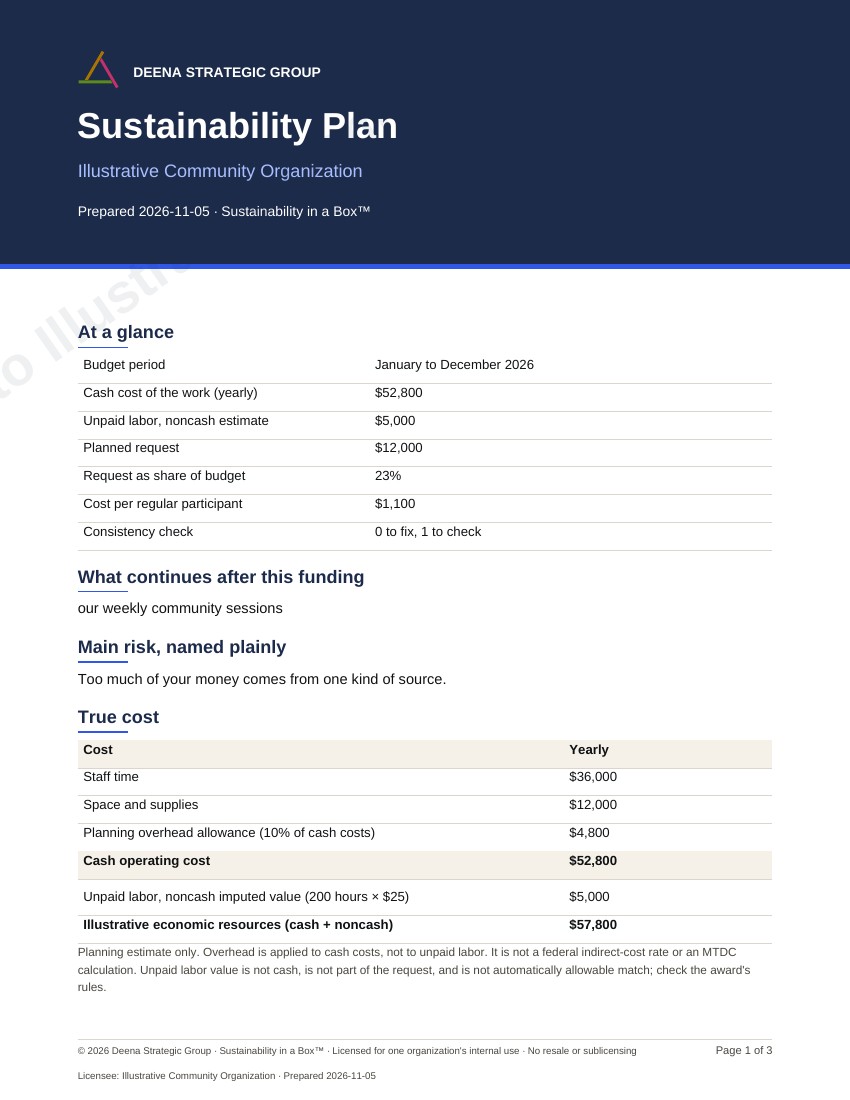
Fictional preview Fictional: program cash cost $142,000; unpaid labor value $38,000 shown separately; one source carries 71% of revenue.
Your work product: A downloadable Sustainability Plan PDF and the same numbers in an editable Excel workbook.
What you enter
What continues, itemized costs, unpaid hours, revenue sources, operating records and evidence of change.
What you get
Eight guided modules, saved editable answers and a downloadable PDF Sustainability Plan.
Delivery & timing
After confirmed payment, sign in using your checkout email to open the existing room. Work at your pace; save each module. The PDF is available in the room.
Your next move
See the full offer, or buy the one-time $149 room. No coaching session or custom board plan is included.
Have both problems? If the deadline is close, start with the application. If the basics are shaky, start with Get Me Ready.
Public examples · No purchase needed
See the work before you choose.
Fictional samples. Every name, number and scenario below is invented to illustrate a format, not client evidence. These are not promised downloads or included custom deliverables.
FICTIONAL · Illustrative application, not a real funder
From the requirement to your evidence.
Staff time + space → 24 planned sessions → attendance records → proposed change in consistent participation. That final change is not yet demonstrated.
Requirement
Stated evidence
Gap / next step
Describe the need
Family interview notes
Confirm dates and consent
Itemized budget
Rent and staffing quotes
Confirm period and shared costs
Explain the change
Attendance log
Does not establish causation
Cost cross-check: Fictional annual cost $24,000 ÷ 40 participants = $600 per participant. If records verify 20 people met a defined outcome, the cost is $1,200 per documented outcome. Neither number proves the program caused that change.
City/county pursuit checklist
FICTIONAL · No live opportunity represented
Find first. Decide whether to pursue. Then prepare.
Record the official city/county source, verification date and deadline time zone.
Check geography, applicant eligibility and whether this is a grant or procurement.
Read allowable costs, reimbursement timing, attachments and match conditions.
Compare the award period with documented cost and available cash.
Confirm unclear requirements with the issuing office before drafting.
Assign an owner to the application, evidence checks and submission receipt.
Unknown: open opportunity, eligibility and match treatment. A search result is not an eligibility decision.
Cash-flow picture & 90-day board plan
FICTIONAL · Supplemental illustration, not an included cash-flow tool
Keep the work going, without guessing.
Month
Opening cash
Receipts / costs
Closing cash
Month 1
$6,000
$4,000 / $5,000
$5,000
Month 2
$5,000
$3,000 / $5,000
$3,000
Month 3
$3,000
$2,000 / $5,000
$0
By day 30: treasurer verifies payment dates and full operating costs.
By day 60: board assigns responsibility for a second funding source.
By day 90: board reviews cash and makes a recorded decision before commitments expand.
The actual $149 room: cost entries, revenue mix, evidence questions and a PDF Sustainability Plan. It does not generate this monthly cash-flow table or custom board plan.
The work belongs to you.
Why: a clear plan lets your board, staff and community see what is being decided.
How: stakeholder engagement means listening to people affected, recording their priorities, and showing what changed in the decision.
Do it: enter actual costs, source requirements and records. Save answers in the available buyer room.
Check it: separate activities from changes, estimates from evidence, and unpaid contributions from cash you can spend.
Take it with you: the Sustainability room exports a PDF; answers remain editable there. The existing grant builder exports Word/PDF drafts when available.
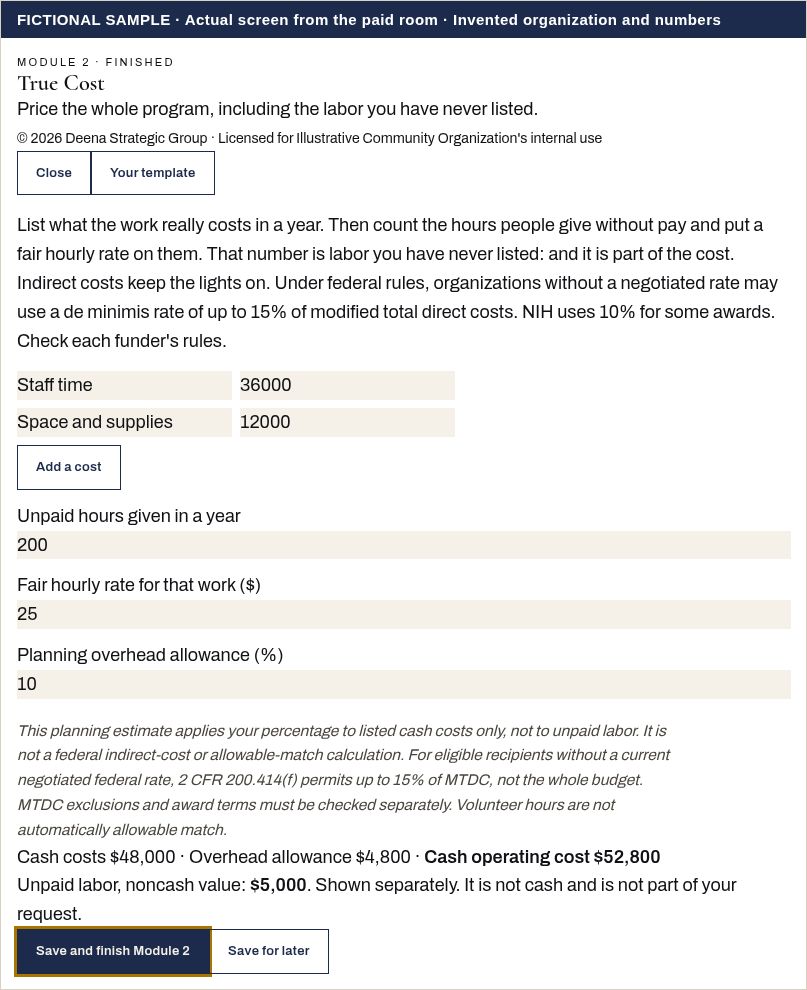
Federal cost caution: 2 CFR 200.414(f) allows eligible recipients/subrecipients without a current negotiated federal indirect cost rate to elect up to 15% of modified total direct costs (MTDC). Do not apply it to the entire budget. MTDC excludes items such as equipment, participant support and the portion of each subaward above $50,000. Check award-specific requirements. Volunteer hours are not automatically allowable match.